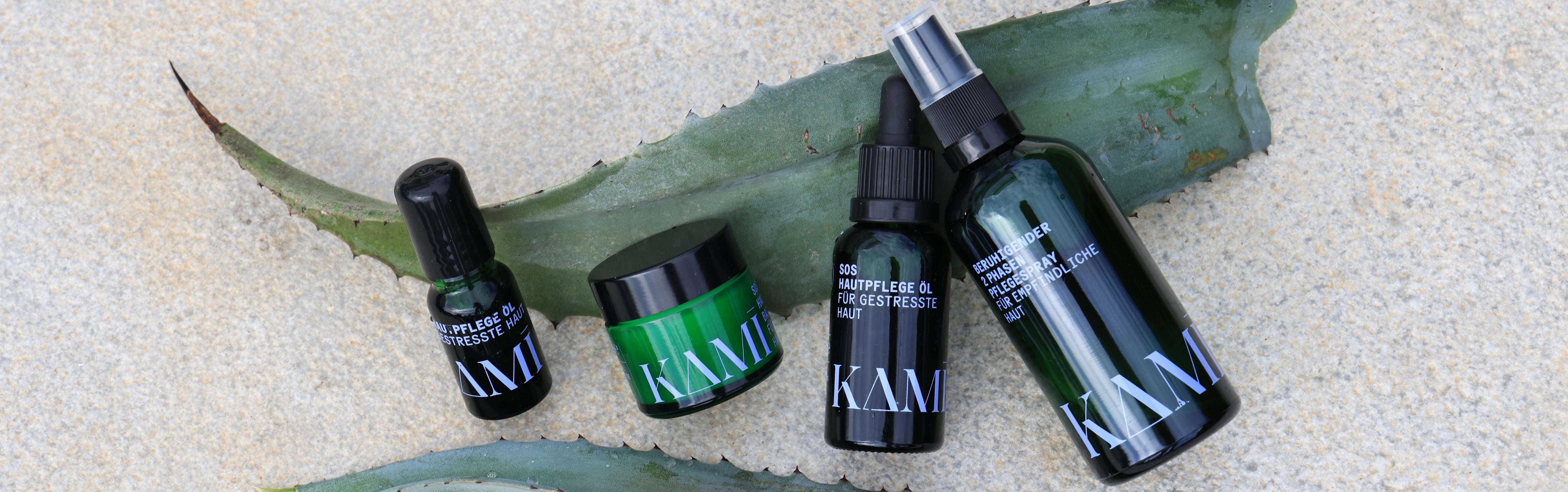
Neurodermatitis, also atopic dermatitis, is a chronic skin condition characterized by dry, itchy, and inflamed skin. Autumn can be a particularly difficult time for people with neurodermatitis, as the cool, dry air and temperature fluctuations can worsen symptoms. Today, Dr. Kerstin Schallaböck, general practitioner, mother of four, and KAMI skincare founder, tells us how best to deal with it.
"In autumn, people also experience a noticeable change in their skin; we shed our coats too, just like our pets. In addition, both children at school and adults are exposed to increased stressors after the restful summer period. This leads to increased sensitivity to potential triggers and allergens. Today I would like to remind you of a few tips that you may have all heard before, but perhaps forget in everyday life":
This is how you care for inflamed skin:
Moisturize:Keep the skin well moisturized by regularly using hypoallergenic, fragrance-free moisturizers or ointments. Avoid products with irritating ingredients. All my KAMI skincare products contain only ingredients that were specifically selected for their positive effect on inflammation.
Gentle cleansing:Always use mild, soap-free cleansers to clean the skin, such as our KAMI Cleansing Fluid. Also avoid hot water, as it can dry out the skin. After washing, gently pat the skin dry instead of rubbing it.
Short baths:Always take short, lukewarm baths or showers so as not to further dry out the skin. Do not add irritating substances such as fragrances or bubble bath to the bath. KAMI Cleansing Fluid is extremely replenishing and almost eliminates the need to apply cream after a bath or shower.
Cotton clothing:Wear loose, breathable cotton clothing to minimize irritation. Avoid synthetic fabrics and tight clothing, as they can irritate the skin.
Avoid heated air:Try to avoid excessive heated air, as it can dry out the air. Use a humidifier to maintain indoor humidity; hanging damp towels or laundry can also help, as can plants that improve the indoor climate (but please not in the bedroom!)
Reduce allergens:Try to reduce allergens that could worsen your neurodermatitis, such as dust mites, pet hair, or pollen. It is better to keep the home uncluttered, clean, and well ventilated.
Soothing compresses:In cases of severe itching, cold, damp compresses can provide temporary relief. Under the damp compress, you can apply, for example, KAMI SOS Skin Care Oil; please pat it gently onto the affected areas of the skin.
Medication: During a flare-up, you should follow your dermatologist's instructions regarding prescribed topical medications or ointments to relieve symptoms; it is important to prevent the areas from becoming bloody and open.
Diet and hydration:Pay attention to a balanced diet and adequate fluid intake, as a healthy diet and sufficient hydration can support skin health. Children often forget to drink enough, so you should remind them from time to time.
Consult a doctor or dermatologist you trust:If symptoms are particularly severe in autumn, it is advisable to arrange an individual treatment plan and possibly adjust your skincare and treatment.
I hope that you can still enjoy this wonderful season and wish you
Recognizing, Understanding, and Properly Treating Perioral Dermatitis (Perioral Rash)
Small, red bumps around the mouth that look like blemishes but simply refuse to heal – no matter how many skincare products you try? That could be perioral dermatitis, colloquially known as "perioral rash." Women who are particularly conscious of their skincare and pay close attention to their skin are often affected and especially irritated by the sudden appearance of these rednesses that look like blemishes. In this article, you will learn what perioral dermatitis is, what the most common triggers are – and what really helps with treatment.
What is perioral dermatitis?
Perioral dermatitis (also known as periorificial dermatitis) is an inflammatory skin rash on the face, typically characterized by small, red papules and pustules around the mouth – often with a narrow, spared strip directly on the lips. Sometimes the rash also spreads to the nasolabial folds or the eye area. Because its appearance resembles acne or rosacea, perioral dermatitis is frequently initially misdiagnosed and treated accordingly.
Women between the ages of 20 and 55 are predominantly affected – around 90% of cases. Occasionally, however, the condition also occurs in children.
Where does the name "stewardess disease" come from?
Perioral dermatitis was previously often referred to as "stewardess disease." The reason: it occurred remarkably often in women whose daily work required an especially intensive facial skincare and makeup routine. This exact connection – many, often rich products on already irritated skin – is still considered one of the main risk factors today.
Perioral Dermatitis: The Most Common Triggers
In addition to overly rich creams and active ingredient serums, common triggers also include certain toothpastes as well as hormonal changes, especially during perimenopause or after pregnancy. Other documented triggers are chewing gum as well as certain ingredients in cosmetics and sunscreen products.
Particularly insidious: facial creams containing corticosteroids. They initially soothe the redness, but often worsen it even more when discontinued – a vicious cycle that many sufferers only realize too late. Topical corticosteroid preparations on the face are therefore considered the strongest known trigger for perioral dermatitis: the short-term improvement leads to continued use of the preparation, while the actual cause of the relapse builds up in the background.
The good news: once the triggers are identified, the right strategy can usually counteract them.
Perioral Dermatitis – What to Do? The Principle of Zero Therapy
In the treatment of perioral dermatitis, the rule of thumb is often: less is more. It is important to completely avoid all skincare products. Often, you are prescribed to use only water for washing and no skincare products at all. This principle of so-called "zero therapy" gives the skin a chance to recover from externally applied irritants and rebuild its own barrier function.
Because many skincare creams, especially those containing silicone, remain on the skin's surface instead of penetrating deep into the skin, they cannot strengthen the skin barrier. Zero therapy gives the skin the freedom to develop on its own again.
However, zero therapy causes many women uncomfortable tightness in the skin. The skin was accustomed to being constantly moisturized – the sudden total avoidance is therefore a change that can take several weeks.
Which products help with perioral dermatitis?
During the strict zero therapy phase, pure water is often sufficient – if you still want to cleanse or do something about the feeling of tightness, we recommend our KAMI Cleansing Fluid during this phase. It cleanses thoroughly but gently and is highly emollient due to its high peach kernel oil content, which minimizes tightness. This keeps the skin clean without being additionally irritated by soap residue, rich additives, or fragrances – completely without corticosteroids, but with anti-inflammatory Copaiba Balm from nature.
Generally, during and after perioral dermatitis, facial cleansing products should be as reduced and mild as possible – soap-free, pH skin-neutral, and emollient. Active ingredients, rich creams, and serums have no place on the skin during this phase.
Important: Do not replace a medical consultation
Perioral dermatitis can easily be confused with acne or rosacea – and the appropriate therapies for each differ significantly. If you suspect you are affected, you should therefore have the diagnosis confirmed by a dermatologist before discontinuing products on your own or using corticosteroids. This applies especially to the sudden discontinuation of existing corticosteroid therapies, as medical supervision is advisable to mitigate a severe rebound flare-up.
Frequently Asked Questions About Perioral Dermatitis
Perioral Dermatitis – What to Do as a First Measure?
The most important thing is to avoid corticosteroids and rich skincare products on the face. A medical consultation helps to reliably distinguish perioral dermatitis from acne or rosacea and to plan the treatment specifically.
Which products to use for perioral dermatitis?
During the zero therapy phase, use as few and as mild products as possible: soap-free, pH skin-neutral, and emollient – such as the KAMI skincare Cleansing Fluid – instead of rich creams, serums, or corticosteroid preparations.
How long does the treatment of perioral dermatitis take?
Zero therapy usually lasts for several weeks. How long exactly depends on the individual course of the condition – dermatological support is recommended here.
Conclusion
Perioral dermatitis is uncomfortable, but well treatable – provided you recognize the actual triggers and give the skin the time and rest it needs to recover. A reduced but well-coordinated cleansing routine with mild, soap-free products like the KAMI Cleansing Fluid can play a crucial role in stabilizing the skin barrier again – completely without corticosteroids.
summertime – hiking season. Parents who love hiking often struggle with how to get their children excited about their hobby. Today, Dr. Kerstin Schallaböck, general practitioner, mother of four, and founder of KAMI skincare, shares her experiences and tips on hiking with children:
A hike, especially with small children, can be fun, but also very strenuous, even if the little ones can already walk longer distances themselves. Even children of kindergarten age sometimes give up after a short time. To avoid this and, above all, not to spoil their joy in movement, even small things help.
My tips for planning a hike with children:
Choose realistic routes, with the youngest child as the benchmark. As commendable as it is to hike with children: It is better to go out into the fresh air several times and plan small routes and activities, than to overwhelm everyone in one day.
If it gets hot, plan shady routes in the forest. (Always apply sunscreen beforehand AND bring it with you, of course!)
The destination should be interesting for children: a great forest playground, an imposing summit cross, a small stream, or a hut that offers their favorite food. Beautiful scenery is – and I say this from experience – rather uninteresting for children.
Many hiking regions offer special activities for children; inquire beforehand at the hotel or tourist office. There are also special children's guides (further links below).
If there is a cable car, spare the children the strenuous ascent and opt for a high-altitude hike instead. There are beautiful viewpoints, often also playgrounds and/or nature trails. Often, cable car tickets are included in the region's tourism offerings (e.g., Hochkönig or Schladming Card).
Games while walking distract from the effort and duration. We always play the word chain game with various themes like first names, fruits/vegetables, countries/cities, etc. The youngest child starts with a word, e.g., their first name, and the next person has to find a new name starting with the last letter (Anna – Andrew – Wendy…).
Tell sagas and fairy tales: Research what sagas exist about the holiday resort or hiking area. While walking, you can tell them and adapt them to make them interesting and exciting for your child. (Tip: there are sagas with dragons, dwarfs, and/or princesses everywhere; if not, you're sure to come up with something 😉!).
Children dehydrate quickly. Make sure to take regular breaks with water (!!!) and small snacks that can also be eaten on the go.
Don't forget to plan the return journey! It often takes longer because the children are already tired and the destination no longer beckons. If the chosen route turns out to be too difficult or too long, it's better to turn back early than to face serious problems on the way back.
Go into the day with an extra portion of motivation and humor, and as a very last resort for motivation, pack a packet of their favorite sweets!
If a toddler is carried in a backpack carrier, make sure their legs are not pinched, and their back and head are well supported and protected. Also, remember that your child is exposed to sun, wind, and weather. The clothing must serve as sun and rain protection and be quickly adaptable to changing temperatures – the higher you go, the colder it gets, even in summer.
Please pack the child's backpack yourself or check the children's backpacks. The little ones should only carry their water bottle, tissues, and a light jacket themselves. Carrying snacks and heavy items should be done by the adults.
Good shoes, however, are almost the most important thing when hiking. They should provide support when walking over stones, cover the ankles, and, above all, have good treads. For my children, waterproof is also extremely important, as every stream is crossed. So no worn-out sneakers, ballet flats, or even sandals!
If it hurts: The right first aid for scrapes
Most importantly, don't go on any excursion without several small and large plasters. Plasters often help even without a wound 😉
Sometimes, however, a scraped knee or elbow really needs to be treated when hiking with children. Over sticks and stones, during a playground trip afterward, or while romping around at a rest stop: a fall can happen quickly. As a doctor and a mom, I know that at that moment, one thing is paramount – acting quickly and correctly, without further irritating delicate children's skin.
My four steps for small scrapes:
Stay calm. First, calm the child, then attend to the wound – that already takes away half the fright.
Clean. Rinse carefully with clear water. Dirt and small stones must be removed; strong disinfectants are usually not necessary for small children.
Pat dry. Do not rub – that further irritates the skin.
Care. A moisturizing, nourishing layer can support healing and alleviate the uncomfortable feeling of tightness.
As soon as a wound is no longer actively bleeding, I like to gently apply our KAMI SOS Oil or the SOS Skin Care Balm. One of the ingredients, marmot oil, has been used for centuries for both minor and major inflammations and skin irritations and contains natural active ingredients that can support skin regeneration and improve scar formation – ideal for sensitive children's skin, but equally for adults. Our roll-on fits in any pocket or backpack and is also a natural companion for the whole summer for itchy mosquito bites.
For falls or blunt traumas, massage in KAMI SOS Oil and stabilize and cool the injured area as best as possible, for example, with a bandage or a cloth.
And very important: For deep, heavily bleeding, or infected wounds, with fever, or if the wound does not improve after a few days, always consult a doctor.
I recommend packing the following in a small bag:
Special blister plasters that won't slip
Small disinfectant spray
2-3 normal plasters in different sizes
KAMI SOS Oil Roll-on for minor wounds, scratches, or insect bites
For allergy sufferers: antihistamines
A small bandage
Steristrips to close more heavily bleeding wounds
Your mobile phone should definitely be with you and charged. You never know what might happen. It's also helpful to write down/save local emergency numbers or the mountain rescue number beforehand.
I hope these tips help you motivate your children for hikes. We parents love hiking very much, and our children do too – when the day is over. 😉
Here are a few more addresses for information:
http://www.bergfex.at
http://www.wanderhotels.com
https://www.bergwelten.com/lp/wandern-mit-kindern
https://outdoorkid.de/wandern-mit-kindern/
https://www.alpenverein.de/bergsport/familie/wandern-bergsteigen-mit-kindern/wandern-mit-kindern_aid_10485.html
In this spirit, I wish you a wonderful and carefree time in the mountains!
Your Kerstin Schallaböck
Anyone who claims that neurodermatitis can only be cured through the gut or that neurodermatitis is solely a gut disease has probably never spent an entire night awake because their skin was unbearably itchy. Because then they would know: When your skin is burning and you're scratching yourself bloody, no food in the world helps – you need something that provides relief now.
Nevertheless, the gut is an important factor in neurodermatitis. Research on the so-called gut-skin axis clearly shows: Your gut microbiome influences your immune system – and thus also your skin. A disturbed gut microbiome can therefore indeed play a role in how often and how severely flare-ups occur. However, the cause of neurodermatitis usually lies elsewhere – namely in the genes.
The gut is therefore rarely the trigger of the disease, but very often an important lever for living better with it. And the skin itself definitely needs its own reliable support. Let's look at why.
Why does neurodermatitis develop? The cause of neurodermatitis
Neurodermatitis (atopic dermatitis) is a chronic inflammatory skin disease. You know the symptoms: dry skin, agonizing itching, red and inflamed areas. But the symptoms are not the cause – they are the result of a complex interplay.
The three main players
Genetic predisposition: In many affected individuals, the production of the protein filaggrin is disrupted. This protein is responsible for forming a stable protective layer on the skin. Additionally, the skin lacks essential fatty acids like linoleic acid, which are necessary for the formation of ceramides – the natural "mortar" between cells. Without these stable building blocks and the protective lipid film, the skin becomes extremely permeable, loses moisture, and easily becomes inflamed because irritants can penetrate more easily.
Overactive immune system: Part of the immune system is overactive in people with neurodermatitis. This mechanism is also at work in hay fever and asthma – which is why many affected individuals suffer from several of these conditions simultaneously.
Disturbed skin microbiome: The excessive immune reaction against parasites simultaneously weakens the defense against bacteria. There is simply less capacity left for defending against bacteria. This makes it easier for germs like Staphylococcus aureus to colonize the skin. Staphylococcus aureus then causes illness when the immune system is weakened or other protective skin bacteria are displaced.
How does a neurodermatitis flare-up occur? Three paths to eczema
Imagine neurodermatitis like a house with an unstable foundation. The foundation is your genetic predisposition – it's there whether you want it or not. But an unstable foundation doesn't automatically lead to collapse. It needs additional stresses: storms, rain, tremors. These stresses are your triggers.
Research shows that there are various ways in which the vicious cycle of inflammation, itching, and scratching begins.
Path 1: The immune system sounds the alarm first
In most affected individuals, an overactive immune system is the starting point. The Th2 cells in the skin are too active, release inflammatory messengers, and dry out the skin. The nerve fibers in the skin are activated – it itches. You scratch, the barrier is further damaged, bacteria settle. The cycle begins.
Path 2: The skin barrier is genetically weakened
Some people initially have genetically dry skin (e.g., due to filaggrin deficiency). The permeable barrier then attracts immune cells, which trigger inflammation.
Path 3: Bacteria on the skin initiate everything
In other cases, bacteria like Staphylococcus aureus first colonize the skin. The immune system reacts, inflammation develops, and the skin dries out.
The crucial point: No matter which path – the same symptoms always result: dry skin, severe itching, inflammatory cells in the skin. And precisely here it becomes clear why a single measure is rarely sufficient. The genetic predisposition is the part that always remains. What can be treated is primarily the resulting inflammatory reaction.
What role does the gut play in neurodermatitis?
Around 70 to 80 percent of your immune cells are located in the intestinal wall. They are in constant exchange with your gut microbiome – the billions of bacteria that colonize your gut. Via this so-called gut-skin axis, the gut influences your entire immune system.
What happens during dysbiosis?
When the balance in the gut is disturbed (experts refer to this as dysbiosis), communication with the immune system changes. Studies show that people with neurodermatitis often have a reduced number of bifidobacteria and less bacterial diversity in their gut. If the gut barrier also becomes permeable (the so-called leaky gut), inflammatory messengers enter the bloodstream – and from there, also the skin.
Can food allergies trigger neurodermatitis?
Neurodermatitis usually arises from congenital immune system disorders – but flare-ups are sometimes triggered by an unsuitable diet or food allergies. This is an important distinction. About two-thirds of neurodermatitis sufferers have an allergic form of the disease.
If you feel that certain foods worsen your flare-ups, I recommend an allergy test with your doctor. If nothing comes out of it, it's more likely that your gut would benefit from a gut cleanse – and not from an elimination diet.
You can find more about the role of nutrition in neurodermatitis in this article.
When can a gut cleanse help with neurodermatitis?
Now it gets specific. A gut cleanse – meaning the targeted establishment of a healthy gut flora through probiotics, prebiotics, and gut-healthy nutrition – can help. But not in every case.
Who benefits most from a gut cleanse
In Path 1 and Path 3 (when the overactive immune system or bacterial colonization come first), a gut cleanse can significantly reduce inflammatory tendencies.
The mechanism: When you restore balance to your gut microbiome, the gut signals to the immune system: "Everything's safe, you can shut down the false alarm." The systemic inflammatory readiness decreases – and that also calms the skin.
A healthy gut immune system also produces protective antibodies and antimicrobial proteins that act on the skin surface. This allows the skin microbiome to stabilize better.
Where gut cleansing reaches its limits
In Path 2 – if the cause is a genetic defect of the skin barrier (e.g., filaggrin deficiency) – no gut cleanse in the world can repair this structural flaw. The skin physically continues to lose too much moisture.
This does not mean that a gut cleanse is useless. It can alleviate the itching cycle because the immune system is less "stimulated." But it does not replace skin care.
Why aren't cortisone, systemic therapy, or a gut cleanse alone sufficient for treating neurodermatitis?
The inflammatory symptoms of neurodermatitis can be treated medically. Systemic therapies – i.e., internally acting medications like Dupilumab – specifically target the messenger substances that originate from the immune system and trigger inflammation in the skin. They interrupt communication between cells, thereby weakening the inflammatory response. But they do not repair the skin barrier!
Cortisone can also temporarily calm the immune system. The problem with this: As long as the dry, weakened skin barrier is not also treated, a rebound effect often occurs – the eczema quickly flares up again after stopping cortisone. And even with ongoing antibody therapy, dry skin is not simply "treated away"; such therapies can be very helpful in severe cases, but they do not replace consistent basic care.
And even if a gut cleanse reduces your inflammatory tendency, one problem remains: Your skin barrier is structurally weakened. And as long as the barrier is not stabilized, eczema will always return – no matter how healthy your gut is.
The three pillars of neurodermatitis treatment
For long-term improvement, you need to address all three components:
Control inflammation – through medical therapy and/or gut cleanse
Stabilize the skin microbiome – by building a healthy bacterial colonization
Care for the skin barrier – through consistent, daily, emollient basic care
If one of the three pillars is missing, the rebound effect occurs. You treat the inflammation, but as soon as you stop, the eczema immediately returns.
Which neurodermatitis skincare really helps?
While a gut cleanse only helps some affected individuals, every person with neurodermatitis benefits from consistent skin care. It is not an optional supplement – it is the foundation.
What matters for neurodermatitis skin
Skin with neurodermatitis needs two things:
Moisture, to compensate for water loss
Lipids (fats), to repair the defective barrier
Especially important are linoleic acid and linolenic acid. The body cannot produce these essential fatty acids itself. They are converted into ceramides in the skin – the aforementioned "mortar" between the skin cells, which is deficient in people with neurodermatitis.
Products containing linoleic and linolenic acids therefore directly support the building of a healthier skin barrier. They replace what the body does not produce sufficiently.
KAMI skincare: For acute phases and as basic care
Our KAMI skincare products were specially developed for sensitive and neurodermatitis-prone skin. They contain:
Linoleic and linolenic acids from high-quality vegetable oils that contribute to the formation of healthy skin
Anti-inflammatory ingredients from nature that provide relief for acute eczema
This makes KAMI versatile: for acute flare-ups to calm the skin and as daily basic care between flare-ups – to postpone the next flare-up for as long as possible.
In acute flare-up phases, the so-called wet wrap, e.g., with the KAMI SOS Skin Care Balm, has proven particularly effective. The wet wrap cools, relieves itching, protects against scratching, and moisturizes the skin. To do this, apply a thick layer of the SOS Skin Care Balm to the affected skin areas and pull a tubular bandage moistened with lukewarm water or black tea over it. Another layer of a second, dry bandage goes over that.
Conclusion: The gut is one piece of the puzzle – but not the whole picture
The gut-skin axis is real. A disturbed gut microbiome can influence the frequency and severity of neurodermatitis flare-ups. For some affected individuals, a gut cleanse is a game-changer.
But: The cause of neurodermatitis is usually genetic. You cannot cleanse it away. What you can do is adjust all the variables – immune system, gut microbiome, skin microbiome and skin barrier, as well as consistently avoiding known triggers – such as stress (cortisol), irritating substances, excessive sweating or certain foods.
And while a gut cleanse takes time and doesn't help everyone equally, consistent skin care works for everyone. It's the part you control yourself – every day.