



"In my practice, I'm noticing increasing openness in discussions about menopause, and that makes me very happy. This phase influences all processes in our body. Our largest organ, the skin, is also a sensitive mirror of hormonal changes.
During menopause – a phase of profound endocrine changes – these changes often first appear on the face. A primary sign is the loss of elasticity: your reflection changes overnight. Many women also report dry skin during menopause, increased sensitivity, a feeling of tightness, or even skin irritations they hadn't experienced before.
Suddenly, products that were previously well-tolerated cause reactions. Today, I want to explain why the skin reacts so intensely during this stage of life and what skin care during menopause is sensible from a medical and scientific perspective."
 Dr. med. Kerstin Schallaböck, holistic general practitioner
and founder of KAMI skincare
Hormones become a skin matter: Why estrogen is a key factor for healthy skin
During perimenopause and menopause, estrogen levels continuously decline and fluctuate. With the drop in estrogen levels, not only does the cycle change – the skin also loses one of its most important "guardian angels." This is because estrogen ensures collagen production, moisture retention, and improved blood circulation.
1. Collagen breakdown and loss of elasticity
Studies show that in the first five years after menopause, the skin loses up to 30% of its collagen. This makes the skin thinner, and it loses firmness and elasticity. The breakdown of collagen softens facial contours – the skin appears more tired, and wrinkles develop.
2. Reduced sebum production – dry skin during menopause
Estrogen regulates the skin's lipid production. When it decreases, less sebum is produced – yet sebum is essential for a stable skin barrier and retaining moisture in the skin.
The result: The skin dries out faster. It begins to itch, feel tight, and develops fine lines. Due to the weakened skin barrier, the skin becomes more sensitive: irritants that were once not a problem now lead to redness, burning, or itching. Fragrances, heat, cold, detergents, and other stressors can trigger irritation more quickly because the skin barrier is more permeable.
ATTENTION: Women with naturally sensitive or neurodermatitic skin feel these changes particularly strongly.
3. Reduced blood circulation
Reduced microcirculation means the skin receives less oxygen and nutrients. Wounds heal slower, and the complexion appears paler and duller.
Typical symptoms include redness, burning, and a feeling of tightness – a condition that strongly resembles sensitive or neurodermatitic skin.
4. Hormonal acne
The ratio between estrogen and androgens shifts, which can lead to more blemishes in the chin and jaw area.
In short: During menopause, the skin becomes drier, thinner, more sensitive, and requires stabilizing, lipid-rich, and non-irritating care.
What strengthens the skin during menopause – scientifically-backed care
1. Strengthening the skin barrier
The most important strategy is to rebuild the disturbed lipid layer. Effective ingredients include:
- Ceramides: Building blocks of the skin barrier
- Linoleic acid / Alpha-linolenic acid: Essential fatty acids (contained in all KAMI products)
- Shea butter: Replenishing and soothing. These substances reduce transepidermal water loss (TEWL) and stabilize the barrier against dehydration.
2. Moisture: Hyaluronic acid & Aloe Vera
Hyaluronic acid stores water in the tissue. Aloe Vera, also found in our KAMI 2-Phase Spray, has a soothing, anti-inflammatory, and hydrating effect. This is ideal for dry, itchy, and sensitive skin during menopause.
3. Non-irritating, pH-neutral cleansing
Use alcohol-free, natural, and pH-neutral cleansing products. Our KAMI Cleansing Fluid supports the skin without further stressing it. This is crucial, especially for hormonally induced sensitive skin.
4. UV protection – the most important anti-aging factor
Since the skin becomes thinner due to estrogen deficiency, many women react more strongly to UV radiation. Daily sun protection remains essential, also to prevent pigment spots.
5. Nutrition & Lifestyle during Menopause
Beauty also comes from within. Pay special attention to:
- Omega-3 fatty acids: Have an anti-inflammatory effect
- Antioxidants: Fresh fruits & vegetables against free radicals.
- Stress reduction: The stress hormone cortisol promotes inflammation – sleep and relaxation are therefore essential for skin health.
- Water: Without internal hydration, the skin also remains dry.
Why KAMI skincare is ideal for menopausal skin
KAMI skincare was originally developed by Dr. Schallaböck for inflammatory, neurodermatitic, and sensitive skin – skin conditions that are very similar to those experienced during menopause: barrier weakness, dryness, and irritation.
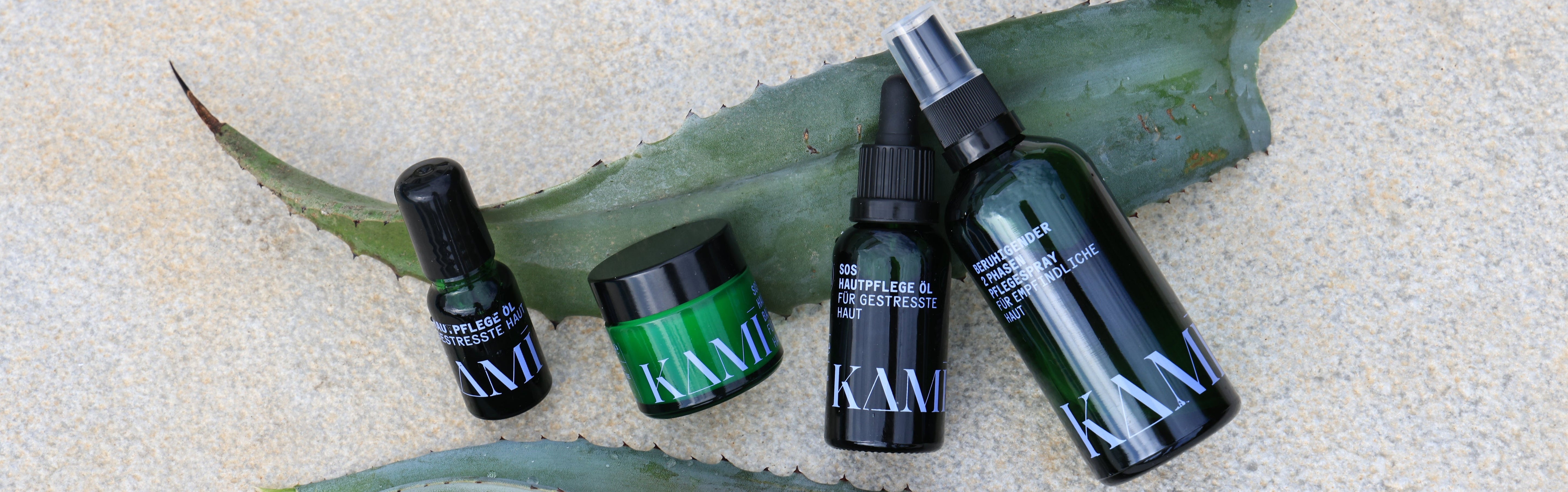
KAMI SOS Skincare Oil
- Barrier-strengthening, anti-inflammatory, smoothing - for dry and stressed skin
- Rich in linoleic acid, alpha-linolenic acid, and antioxidant plant compounds
KAMI SOS Balm
- With shea butter, grapeseed oil, and soothing plant extracts
- Ideal for flaky areas, dry corners of the mouth, irritated cuticles, or skin cracks
KAMI 2-Phase Care Spray
- Aloe Vera + lipid-rich oils in an ultra-mild formulation
- Perfect for very dry and sensitive skin on the body and face
KAMI Cleansing Fluid
- Gentle, lipid-replenishing cleansing
- Essential for dry, sensitive skin during menopause
My personal tip as an expert: Always apply oil products to slightly damp skin – this way they bind water even more effectively.
I hope to have answered your questions:
- Which face cream for menopause?
- Why does skin itch during menopause?
- What helps against hormonal acne after 50?
If you have any further questions, please feel free to contact us. We are happy to help: info@kami-skincare.com
All the best,
Dr. med. Kerstin Schallaböck
This article first appeared in an abridged form on Gesundheitscode.de. There you will find more on the topic of menopause and many other health topics from doctors.
If you are interested in this topic, you can find more in the following studies:
- "Estrogen-deficient skin: The role of topical therapy“, International Journal of Women’s Dermatology (2019)
- „Estrogen and skin: The effects of estrogen, menopause, and hormone replacement therapy on the skin“, Journal of the American Academy of Dermatology (2005)
- „A role for estrogen in skin ageing and dermal biomechanics“, Mechanisms of Ageing and Development (2021)
- „Dermatological Changes during Menopause and HRT: What to Expect?“, MDPI (2025)