



Anyone who claims that neurodermatitis can only be cured through the gut or that neurodermatitis is solely a gut disease has probably never spent an entire night awake because their skin was unbearably itchy. Because then they would know: When your skin is burning and you're scratching yourself bloody, no food in the world helps – you need something that provides relief now.
Nevertheless, the gut is an important factor in neurodermatitis. Research on the so-called gut-skin axis clearly shows: Your gut microbiome influences your immune system – and thus also your skin. A disturbed gut microbiome can therefore indeed play a role in how often and how severely flare-ups occur. However, the cause of neurodermatitis usually lies elsewhere – namely in the genes.
The gut is therefore rarely the trigger of the disease, but very often an important lever for living better with it. And the skin itself definitely needs its own reliable support. Let's look at why.
Why does neurodermatitis develop? The cause of neurodermatitis
Neurodermatitis (atopic dermatitis) is a chronic inflammatory skin disease. You know the symptoms: dry skin, agonizing itching, red and inflamed areas. But the symptoms are not the cause – they are the result of a complex interplay.
The three main players
- Genetic predisposition: In many affected individuals, the production of the protein filaggrin is disrupted. This protein is responsible for forming a stable protective layer on the skin. Additionally, the skin lacks essential fatty acids like linoleic acid, which are necessary for the formation of ceramides – the natural "mortar" between cells. Without these stable building blocks and the protective lipid film, the skin becomes extremely permeable, loses moisture, and easily becomes inflamed because irritants can penetrate more easily.
- Overactive immune system: Part of the immune system is overactive in people with neurodermatitis. This mechanism is also at work in hay fever and asthma – which is why many affected individuals suffer from several of these conditions simultaneously.
- Disturbed skin microbiome: The excessive immune reaction against parasites simultaneously weakens the defense against bacteria. There is simply less capacity left for defending against bacteria. This makes it easier for germs like Staphylococcus aureus to colonize the skin. Staphylococcus aureus then causes illness when the immune system is weakened or other protective skin bacteria are displaced.
How does a neurodermatitis flare-up occur? Three paths to eczema
Imagine neurodermatitis like a house with an unstable foundation. The foundation is your genetic predisposition – it's there whether you want it or not. But an unstable foundation doesn't automatically lead to collapse. It needs additional stresses: storms, rain, tremors. These stresses are your triggers.
Research shows that there are various ways in which the vicious cycle of inflammation, itching, and scratching begins.
Path 1: The immune system sounds the alarm first
In most affected individuals, an overactive immune system is the starting point. The Th2 cells in the skin are too active, release inflammatory messengers, and dry out the skin. The nerve fibers in the skin are activated – it itches. You scratch, the barrier is further damaged, bacteria settle. The cycle begins.
Path 2: The skin barrier is genetically weakened
Some people initially have genetically dry skin (e.g., due to filaggrin deficiency). The permeable barrier then attracts immune cells, which trigger inflammation.
Path 3: Bacteria on the skin initiate everything
In other cases, bacteria like Staphylococcus aureus first colonize the skin. The immune system reacts, inflammation develops, and the skin dries out.
The crucial point: No matter which path – the same symptoms always result: dry skin, severe itching, inflammatory cells in the skin. And precisely here it becomes clear why a single measure is rarely sufficient. The genetic predisposition is the part that always remains. What can be treated is primarily the resulting inflammatory reaction.
What role does the gut play in neurodermatitis?
Around 70 to 80 percent of your immune cells are located in the intestinal wall. They are in constant exchange with your gut microbiome – the billions of bacteria that colonize your gut. Via this so-called gut-skin axis, the gut influences your entire immune system.
What happens during dysbiosis?
When the balance in the gut is disturbed (experts refer to this as dysbiosis), communication with the immune system changes. Studies show that people with neurodermatitis often have a reduced number of bifidobacteria and less bacterial diversity in their gut. If the gut barrier also becomes permeable (the so-called leaky gut), inflammatory messengers enter the bloodstream – and from there, also the skin.
Can food allergies trigger neurodermatitis?
Neurodermatitis usually arises from congenital immune system disorders – but flare-ups are sometimes triggered by an unsuitable diet or food allergies. This is an important distinction. About two-thirds of neurodermatitis sufferers have an allergic form of the disease.
If you feel that certain foods worsen your flare-ups, I recommend an allergy test with your doctor. If nothing comes out of it, it's more likely that your gut would benefit from a gut cleanse – and not from an elimination diet.
You can find more about the role of nutrition in neurodermatitis in this article.
When can a gut cleanse help with neurodermatitis?
Now it gets specific. A gut cleanse – meaning the targeted establishment of a healthy gut flora through probiotics, prebiotics, and gut-healthy nutrition – can help. But not in every case.
Who benefits most from a gut cleanse
In Path 1 and Path 3 (when the overactive immune system or bacterial colonization come first), a gut cleanse can significantly reduce inflammatory tendencies.
The mechanism: When you restore balance to your gut microbiome, the gut signals to the immune system: "Everything's safe, you can shut down the false alarm." The systemic inflammatory readiness decreases – and that also calms the skin.
A healthy gut immune system also produces protective antibodies and antimicrobial proteins that act on the skin surface. This allows the skin microbiome to stabilize better.
Where gut cleansing reaches its limits
In Path 2 – if the cause is a genetic defect of the skin barrier (e.g., filaggrin deficiency) – no gut cleanse in the world can repair this structural flaw. The skin physically continues to lose too much moisture.
This does not mean that a gut cleanse is useless. It can alleviate the itching cycle because the immune system is less "stimulated." But it does not replace skin care.
Why aren't cortisone, systemic therapy, or a gut cleanse alone sufficient for treating neurodermatitis?
The inflammatory symptoms of neurodermatitis can be treated medically. Systemic therapies – i.e., internally acting medications like Dupilumab – specifically target the messenger substances that originate from the immune system and trigger inflammation in the skin. They interrupt communication between cells, thereby weakening the inflammatory response. But they do not repair the skin barrier!
Cortisone can also temporarily calm the immune system. The problem with this: As long as the dry, weakened skin barrier is not also treated, a rebound effect often occurs – the eczema quickly flares up again after stopping cortisone. And even with ongoing antibody therapy, dry skin is not simply "treated away"; such therapies can be very helpful in severe cases, but they do not replace consistent basic care.
And even if a gut cleanse reduces your inflammatory tendency, one problem remains: Your skin barrier is structurally weakened. And as long as the barrier is not stabilized, eczema will always return – no matter how healthy your gut is.
The three pillars of neurodermatitis treatment
For long-term improvement, you need to address all three components:
- Control inflammation – through medical therapy and/or gut cleanse
- Stabilize the skin microbiome – by building a healthy bacterial colonization
- Care for the skin barrier – through consistent, daily, emollient basic care
If one of the three pillars is missing, the rebound effect occurs. You treat the inflammation, but as soon as you stop, the eczema immediately returns.
Which neurodermatitis skincare really helps?
While a gut cleanse only helps some affected individuals, every person with neurodermatitis benefits from consistent skin care. It is not an optional supplement – it is the foundation.
What matters for neurodermatitis skin
Skin with neurodermatitis needs two things:
- Moisture, to compensate for water loss
- Lipids (fats), to repair the defective barrier
Especially important are linoleic acid and linolenic acid. The body cannot produce these essential fatty acids itself. They are converted into ceramides in the skin – the aforementioned "mortar" between the skin cells, which is deficient in people with neurodermatitis.
Products containing linoleic and linolenic acids therefore directly support the building of a healthier skin barrier. They replace what the body does not produce sufficiently.
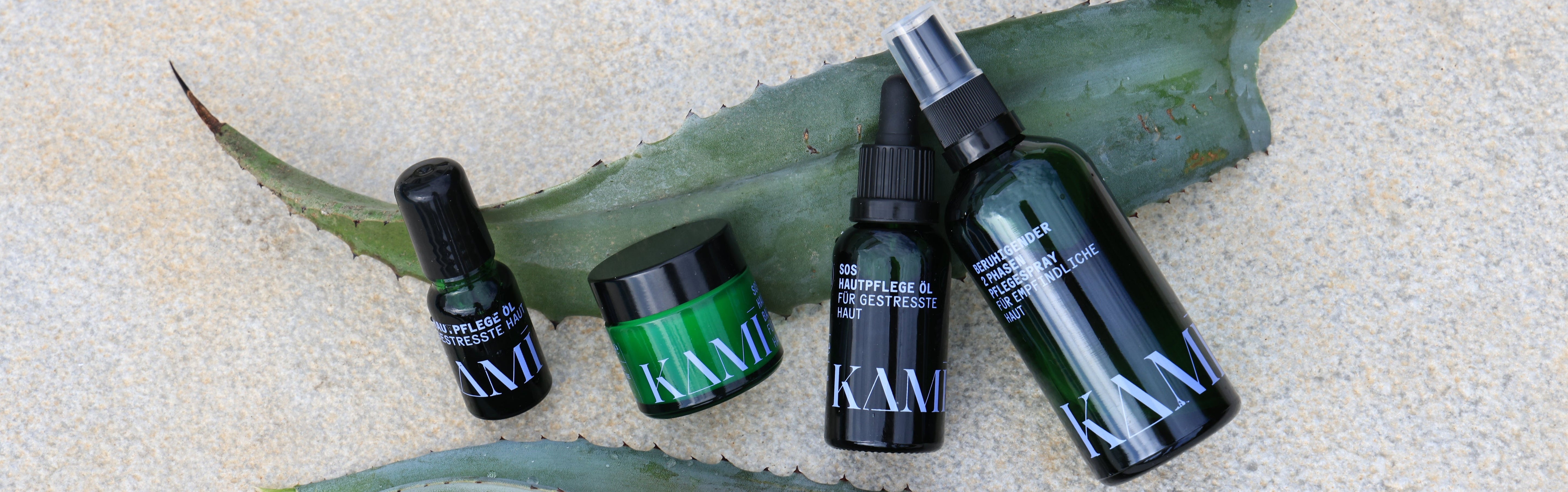
KAMI skincare: For acute phases and as basic care
Our KAMI skincare products were specially developed for sensitive and neurodermatitis-prone skin. They contain:
- Linoleic and linolenic acids from high-quality vegetable oils that contribute to the formation of healthy skin
- Anti-inflammatory ingredients from nature that provide relief for acute eczema
This makes KAMI versatile: for acute flare-ups to calm the skin and as daily basic care between flare-ups – to postpone the next flare-up for as long as possible.
In acute flare-up phases, the so-called wet wrap, e.g., with the KAMI SOS Skin Care Balm, has proven particularly effective. The wet wrap cools, relieves itching, protects against scratching, and moisturizes the skin. To do this, apply a thick layer of the SOS Skin Care Balm to the affected skin areas and pull a tubular bandage moistened with lukewarm water or black tea over it. Another layer of a second, dry bandage goes over that.
Conclusion: The gut is one piece of the puzzle – but not the whole picture
The gut-skin axis is real. A disturbed gut microbiome can influence the frequency and severity of neurodermatitis flare-ups. For some affected individuals, a gut cleanse is a game-changer.
But: The cause of neurodermatitis is usually genetic. You cannot cleanse it away. What you can do is adjust all the variables – immune system, gut microbiome, skin microbiome and skin barrier, as well as consistently avoiding known triggers – such as stress (cortisol), irritating substances, excessive sweating or certain foods.
And while a gut cleanse takes time and doesn't help everyone equally, consistent skin care works for everyone. It's the part you control yourself – every day.