



Dear KAMI skincare friends,
Mother's Day is approaching, and this year I'm taking the opportunity to bring up a topic that is truly close to my heart as a doctor and a mother of four: stress and what it does to our skin. Especially the skin of people suffering from neurodermatitis – children and adults alike.
This time, I asked myself the questions. In this interview format, you can virtually look over my shoulder.
"How does an unhealthy cortisol level develop?"
Cortisol is not an enemy – I want to say that first. It's a hormone we need. In the morning, when it wakes us up, when it protects us in dangerous situations, when it regulates inflammation. The problem doesn't arise from cortisol itself, but from chronic stress, which disrupts this natural regulatory cycle.
What happens in the body? If the brain – more precisely the hypothalamus – perceives a threat, a chain reaction is triggered via the so-called HPA axis (hypothalamic-pituitary-adrenal axis): CRH → ACTH → Cortisol. Originally intended as protection from the saber-toothed tiger outside the cave. Today, this saber-toothed tiger is found in a child's school stress, in an overflowing email inbox, in the sleepless third year with a baby suffering from neurodermatitis, in the stress between work and household chores.
As a mother, I know all of this. To be honest: the cortisol levels of many mothers are structurally elevated. Not because we are weak, but because we are carrying too much at once. Lack of sleep, constant mental presence, worry about a child with neurodermatitis, our own exhaustion. This is not personal failure. This is biology.
"What exactly does chronically elevated cortisol do to the skin – including in neurodermatitis?"
That is the question that fascinates me as a doctor and concerns me as a mother.
In the short term, cortisol has an anti-inflammatory effect, which is why it is also used medically. But chronically elevated cortisol paradoxically promotes inflammation. It weakens the skin barrier, reduces the production of ceramides and harmful lipids that hold our skin together protectively, and it lowers the production of antimicrobial peptides such as beta-defensin and cathelicidin. In short: the skin loses its protective wall.
For people with neurodermatitis (atopic dermatitis), this is particularly dramatic because their skin barrier is already genetically weakened. An elevated cortisol level due to stress is like removing the last protective layer.
A 2024 study (DOI: 10.1111/jocd.16634) impressively shows how chronic psychological stress, through the release of cortisol and epinephrine, not only accelerates skin aging but also promotes diseases such as atopic dermatitis, psoriasis, and acne. Directly measurable in cell damage, reduced wound healing, and impaired barrier function.
And current research confirms this. A study from March 2026, published in the renowned journal Science (Tian et al., DOI: 10.1126/science.adv5974), provides the first clear molecular evidence of how stress affects the brain and skin, and why certain immune cells in the skin overreact in stressed patients with neurodermatitis. So it is no longer just a suspicion – stress and neurodermatitis flare-ups are biochemically directly linked.
"How do mothers of children with neurodermatitis experience this specifically?"
I am often asked: Why does it always get worse for the child during school exam week? Why does neurodermatitis flare up exactly when things are tense at home? Why is the skin much better on holiday?
The answer is simple yet complex: children feel their parents' stress and they process their own stress physically – often through their skin. Neurodermatitis in children is deeply psychosomatic. This does not mean that parents are to blame – it is the opposite! It means that stress reduction in family life is active medicine.
At the same time, the image of a stressed mother of a child with neurodermatitis is physically burdened: she sleeps poorly because the child is itching and scratching at night. She carries feelings of guilt. She feels helpless. I know this very helplessness from my own story – it led me to develop KAMI skincare.
"What is the effect of sleep deprivation and why is it particularly dangerous for neurodermatitis sufferers?"
Sleep is the most important cortisol brake we have. At night, cortisol levels naturally drop. This is the moment when the skin regenerates, inflammation subsides, and the barrier renews itself.
If this window is chronically absent – due to an itchy child calling out, or one's own racing thoughts – cortisol levels do not drop sufficiently at night. The skin does not calm down. Neurodermatitis flare-ups in children and adults are directly exacerbated at night by lack of sleep. It is a vicious circle: itching disrupts sleep – lack of sleep increases cortisol – increased cortisol intensifies itching.
"What can be done specifically? Which rituals help regulate cortisol levels?"
And now we come to what I really want to share – not as a doctor with a prescription pad, but as a mom who practices it herself daily.
Rituals are powerful because they signal security to the brain. Regularity is the opposite of threat. When the body knows: now is this moment for me, it already starts to calm down.
Here are the rituals I recommend and practice myself:
🌿 1. The Evening Skincare Ritual – Medicine and Care in One
For me, oiling or creaming my child in the evening is more than just care. It is contact, reassurance, ritual. Studies on massage for children with neurodermatitis show that regular, gentle touch not only supports the skin barrier but also lowers stress hormones in both parents and child.
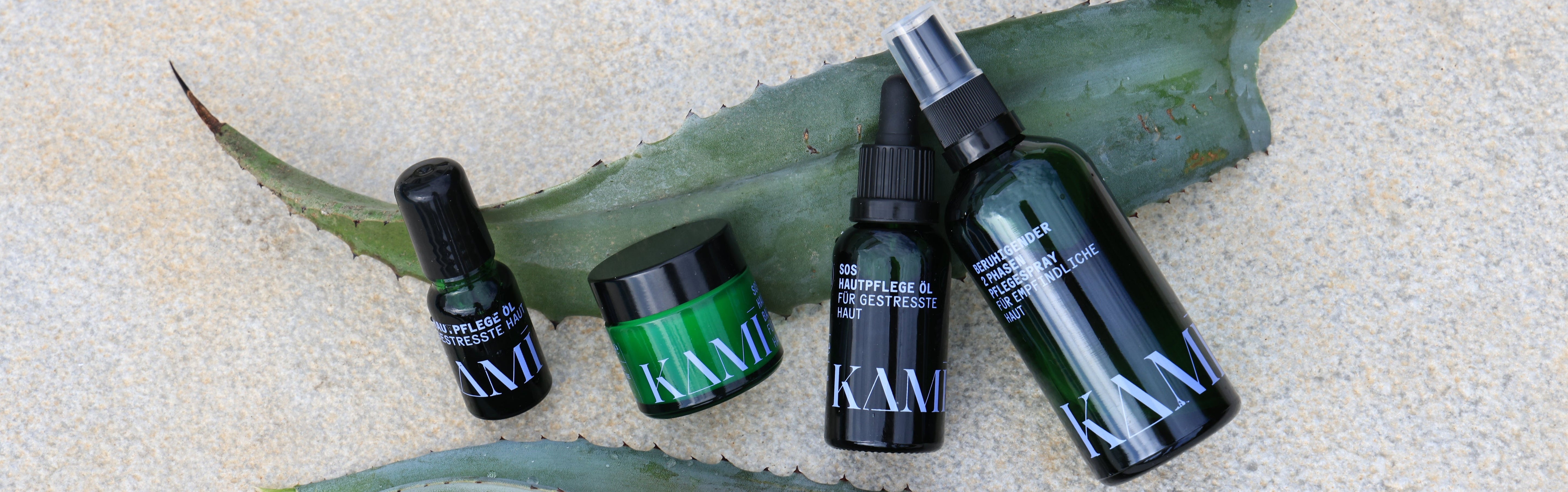
When I apply KAMI SOS Skincare Oil to my son's dry areas in the evening – calmly, mindfully, with the scent of lavender and blue chamomile – it's not an annoying chore. It's our quietest moment of the day. Care as a shared ritual creates security. For the child and for you as a mom.
🌬️ 2. Breathing Exercises – Underestimated and Highly Effective
Three deep breaths. Sounds trivial. It is not. Deep diaphragmatic breathing activates the parasympathetic nervous system – the opposite of the stress system. In research, breath control is considered one of the fastest, most accessible ways to lower cortisol. You don't need an app, a course, or equipment.
My tip for stressful moments: Inhale for 4 seconds, hold for 4 seconds, exhale for 6 seconds. This takes two minutes. And it works, even at the playground, in the waiting room, during a doctor's appointment.
🌲 3. Spend 20 minutes in nature
Research shows that just 20 minutes in nature can measurably lower cortisol levels. Not exercise, not performance – just being outdoors. A walk. Barefoot on grass. Even the green space at the playground is enough! Or at least open the window.
For children with neurodermatitis: Fresh air (outside pollen season!) is therapeutic. Cool, humid air soothes irritated skin. And shared time in nature calms the entire family's stress system.
☀️ 4. The Morning Routine as an Anchor
Chaos in the morning = elevated cortisol start. A calm morning, even if it took 10 minutes longer, lowers the stress level for the entire day.
My personal morning anchor: Before I look at my phone, I calmly drink my tea. Sometimes that one cup is exactly what makes the difference.
🧴 5. Self-Care – Not Least
Mothers of children with neurodermatitis selflessly care for their children and forget themselves. However, medically speaking: if you are under constant stress, your immune regulation suffers. Your own skin. Your capacity for patience.
Self-care is not a weakness. It is a prerequisite.
I say this to myself too: the five minutes you spend caring for your face and consciously breathing are not a luxury. That is regulation, prevention. For you, and therefore also for your child.
"What would you advise mothers who suffer from neurodermatitis themselves?"
There are many mothers who themselves suffer from neurodermatitis, and at the same time care for a child with neurodermatitis. Double burden, double necessity.
My advice: Treat your own skin with the same care as your child's. No guilt. No shortcuts in your own care. If the mother is in a flare-up phase, the child feels it. The cycle of stress, skin reaction, and exhaustion affects the whole family.
Neurodermatitis in children and mothers needs the same things: consistency, gentleness, and routines.
A word on Mother's Day
For me, Mother's Day means: don't buy roses, but pause. Say thank you to yourself. For everything you carry. For the sleepless nights, the gentle hands when applying cream, the long breath.
If you read this article and are looking for a gift for yourself – or someone for you: A peaceful ritual is the most valuable gift. And if a KAMI product helps to turn a minute of care into a real moment of tenderness – then I am very happy.
With that in mind: Happy Mother's Day – from doctor to mom, from mom to mom.
Yours, Kerstin
Dr. med. Kerstin Schallaböck General practitioner, mother of four, founder of KAMI skincare
Further links & studies:
- Tian et al. (2026): Stress and atopic dermatitis at the molecular level – Science: DOI: 10.1126/science.adv5974
- Pujos et al. (2024): Chronic stress and skin diseases including atopic dermatitis – Journal of Cosmetic Dermatology: DOI: 10.1111/jocd.16634
- Mizawa et al. (2013): Salivary cortisol levels in patients with atopic dermatitis – NCBI: PMC3736503